How do Factors of Democratization, Backsliding, and Revolution Play into the Possibility of a Catalonian Secession? (2023)
Catalonia (Cataluña) is a region of Spain located on the northeastern coast, just south of Andorra and France. It is known for the city of Barcelona and is a wealthy region, gaining its wealth from its textile, food-processing, and metalworking industries (1) . In recent years, Catalonia gained popularity for the idea of secession from Spain. Despite making up about 6.5% of Spain’s territory, Catalonia has produced around 20% of Spain’s national GDP (2). However, secession has only begun being a serious idea for Catalonians in the last decade. In 2010, support for independence was reportedly around 20% (3) .
Catalonia has many pieces in play for its sovereignty as an independent nation away from Spain, and in no way should it be examined as a simple situation. However, by looking at past studies and informational pieces, we can piece together if Catalonia is in a state where an uprising or revolution is imminent or if the ideas of secession are no longer a priority based off the explanations for democratization.
First, we must define the points of democratization (Modernization/Economic Development, Civil Society, Geopolitical/International Relations, Elites, and Culture).
Modernization theory or economic development can be shown through a decrease in agriculture industries and an increase in other industries and services (4) . This growth can be effectively shown through an increase of the middle class and an evaluation of values to replace old ideas with newer ones. Civil Society relies on the assertiveness of a population. This is because it is the collective activity outside of state groups. Book clubs, sports teams, Habitat for Humanity, PETA, and so many other groups are great examples of civil society and its strength. Geopolitical or International Relations are somewhat self-explanatory. If a state is more open to connecting with multiple outside states, then they will have more opportunity to democratize. Elites come from the higher ups in a country. Those who invest into a state have more at play as it grows in power. Elites fear democracy as it opens potential to losing said power to the lower classes of people. However, there are examples of the opposite. If power can be gained and kept through democratization, then the elites will support it to benefit in the end. Finally, culture. While in some cases, the argument for this point is ‘western culture’, in this example I plan on evaluating it as the strength of values and traditions in a state. Catalonia, despite being a small region, holds 16% of Spain’s population (5). This is important in looking into other pieces of revolution (i.e. Collective Action, History of Political Violence, etc.). With a rich and growing history, plenty of information has been released on the region as an individual rather than as a small piece of Spain. This makes it easier to evaluate the nations actions as their own.
Catalonia’s development is not shown through the same growth factors as we would expect from explanations for democratization. Catalonia’s history as a textile capital and modernizing into a metalworking and food-processing focused state aid with the idea of modernizing, however, there has not been the growth that may be seen from a state moving away from a non-democracy. Antoni Castells talks about the history of the financial conflict between the two groups in an article he published in 2017. “The conflict between Catalonia and Spain is a very good example in this respect. When, in the second half of the XIX century, Catalonia emerged as a powerful industrial region leading the Spanish economy, a political movement of national affirmation arose with special strength: Catalanism.” (6) This builds an idea that the wealth of the region comes from the nationalist pride of Catalonians (which is what he means by Catalanism). However, his article goes further to discuss the territorial bounds and its ties to the financial situation.
In his conclusion he states, “I should stress the close relationship between economic and political issues in territorial conflicts, particularly within a state. These conflicts take very often an economic or financial expression, though there are usually powerful underlying political factors.” (7) As previously discussed, the GDP of Spain which is produced by Catalonia is a large percentage, strengthening the argument that the relationship between finances and territorial politics is close. The featured statista graphic (fig. 1) illustrates this as well. We can see that the GDP is stable for Catalonia, so there does not seem to be the democratization growth in recent years.
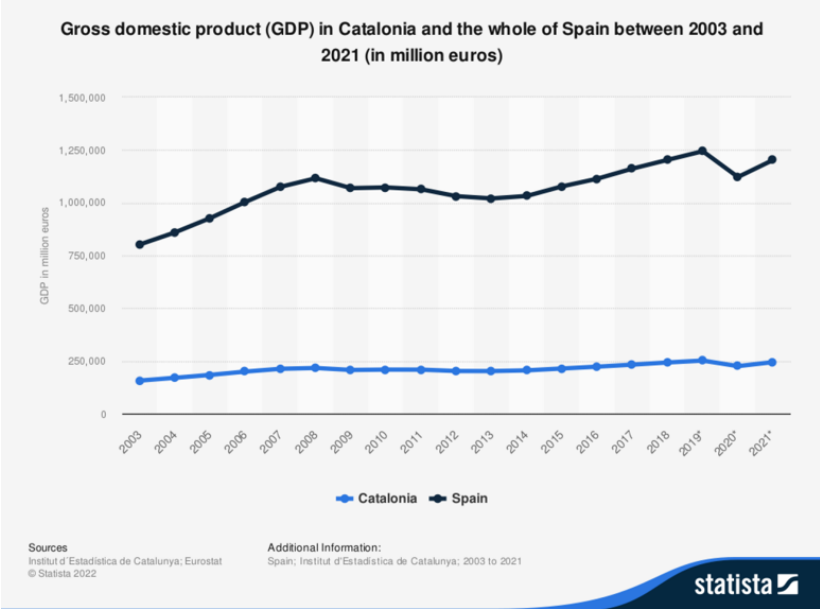
Figure 1: Chart of the GDP of Spain and Catalonia between 2003 and 2021 (Data from Statista). (8)
After examining the modernization of Catalonia, we cannot claim that this has much of an effect towards the push of a secession due to the matched modernization of Spain and their already existing status of being a democracy.
Continuing, Civil Society is rich in Catalonia due to the richness of culture not only the region, but the entire nation of Spain. There is plenty of population activity outside of statesponsored activity. One example of this is the culture surrounding the professional soccer team, FC Barcelona. More relevant to the conflict is a group which has fought for the secession for years: The Catalan National Assembly (ANC).
While there is enough civil society which would benefit the secession decision, it is necessary to discuss the counters. The biggest of which is the Societat Civil Catalana (SCC) or the Catalonia Civil Society. Based in Barcelona, this organization works to counter the actions of pro-independence movements in Catalonia. In a direct quote from their website, they claim, “Founded in April 2014 with the aim of recovering constitutionalist Catalonia from the nationalist regime.” (9) It is rather obvious that such an organization would exist. However, despite the support from the European Union, it failed in the past to gain enough traction inside the nation as a driving persuasion tool away from the secession movement.
Despite being not as effective as needed, it shows that time may have been the factor needed. While in the past, millions of Catalonians have shown up on the 11th of September for protests to support independence from Spain, this year was less intimidating for the Spanish government. Organizers gave 700,000 as the figure for participants in this year’s protest, however local police claim that those there only totaled to around 150,000 protestors. (10) This is detrimental as it also builds into the issue of numbers with a movement like this. The decline in participation could be due to covid regulations in recent years, however with other protests showing more protestors makes this explanation improbable.
Moving into the next factor, Geopolitical Relations have played a large part in this conflict. Spain is a member of both the North Atlantic Treaty Organization (NATO) as well as the European Union (EU). While it may not openly make sense for those groups to play a part in fighting to keep Catalonia, more desperate actions have been taken which result in more attention from both NATO and the EU.
In September for 2021, Radio Free Europe reported that separatists went and asked Russia for aid in their attempts to leave Spain. While there is no evidence to the claims, Josep Lluis Alay, an advisor to previous Catalan President Carles Puigdemont, met with Moscow officials on multiple occasions in 2019. These claims were deflected by Alay saying that the story was “a fantasy story created by Madrid.” (11)
Whether or not the claims are true, it makes sense that Spain would call upon NATO and the European Union due to shaky relationships between both of those groups and Russia. This creates a potential security risk for Spain as it opens opportunity for violence against the state (terrorism) as well as bad relations with a neighboring state if a successful revolution were to occur.
The international relations for this conflict are an important part to unlocking this for both sides. Outside aid may be the answer to forcing Spain into more serious discussions of secession while getting more attention from those who are set to lose on this separation can increase force against separatists.
Having Elites and wealthy groups which invest into your situation is also impactful for democratization. In this case, member states of those international groups (NATO and the European Union) have shown that if Russia aids in the secession of Catalonia, there is much to lose for them. As far as losses from either side, it seems as if Spanish investors may have more to worry about because of the wealth which comes from Catalonia. Tourism alone is a large blow to investors. This is increased by the international investments into the previously mentioned FC Barcelona soccer team, which was valued at $5 Billion USD, (12) second only to another Spanish National soccer team: Real Madrid (Valued at $5.1 Billion USD). (13) Spain holds the two most valued professional soccer teams on the planet and would lose $5 Billion USD in a separation.
While this is not focused on behalf of Catalonia, following elites/wealthy investments can help to see how a conflict will be swayed, democracy or not.
The final factor for democratization is culture. Culture typically fits into the idea of western culture, something already prevalent in Spain/Europe. Culture essentially ties the previous speaking points together to build more of an argument towards no successful secession. The factors given already have pieces which may suggest that there could be revolution, but in the long term, it would not prove to be successful.
However, the democratic backsliding shown through Spain’s counter secession tactics prove to be a justifying reason for secession.
On November 9, 2014, Catalonia held a referendum on independence, which was challenged as illegal by Prime Minister Mariano Rajoy. (14) This referendum was inspired by the similar referendum which occurred in Scotland of the same year. The Catalonian referendum was eventually accepted as a poll for the public’s opinion and exhibited over an 80% vote of support for independence for the region. Another referendum took place on October 1, 2017 by then Catalonian President Carles Puigdemont
This vote is not surprising. In Castells article (as previously mentioned), he reports that “45.9% of citizens in Catalonia feel themselves exclusively Catalan or more Catalan than Spanish, while in the rest of Spain the same percentage.” (15) This nationalist pride is a very important detail here because it shows an impressive connection from the people. This is similar to if New Yorkers began rising up to declare Manhattan as its own country separate from the US because they felt that they were Yankees instead of Americans.
The Guardian quotes one protestor saying “We’re carrying the fight on…The politicians aren’t but we are. There’s no point negotiating with Madrid – we have to fight this ourselves and we will.” (16) This mindset shows the determination of some of those who believe in the movement. With the violent force being displayed by Spanish Armed Forces/Police Forces (i.e. “…raiding of polling stations, beating of voters and firing of rubber bullets…” (17)), it is no wonder that there is a strong emphasis of nationalism from those who wish to separate. Spain’s use of violence against referendum voters and poll workers shows democratic backsliding in a dangerous amount. Whether or not Catalonia secedes is a matter of public opinion, something which Spain does not want to take place.
On the other hand, we must consider Catalonia’s efforts. In September of 2019, 7 separatists were arrested on charges of connection to a terrorist organization. (18) Few details of these arrests were given, however the charges included illicit explosives in the separatist’s possession. Moving from protests into terrorism is a large step for a group as it shows a drop in morals. This shows that separatists are willing to take innocent lives to intimidate the Spanish state into negotiating with them for their demands.
It is also important to bring up the issues with numbers. While terrorism can be an effective tool, it also can deter other potential members of the movement. Unfortunately, there is no collection of data which shows that the few instances of terrorism lowered participation for the independence movement. While it may have not been the terrorism, the drop in numbers as well as the misinformation of numbers by organizers is a numbers issue which can have a lasting effect. (19) A movement for independence is one which needs mass support from the public. A referendum with 80% population support is one thing, but when it declines rapidly to only 150,000 protestors, it is foreseeable that the movement is dead.
In conclusion, the factors are, for the most part, still there. Catalonia has had a long history with Spain, and recent history would’ve been the reason to secede. However, the lack of modernization to outgrow Spain made it so that it is financially still tied to Spain. Culture and Civil Society is there in enough magnitude that it could persuade elites to begin putting more and more money into Catalonia and ultimately aid in its separation. The geopolitical relation claims are there, but due to no confirmation on their validity it is not my position to evaluate if it would or would not impact the revolution. Catalonia has more reason to cause an uprising because of the lack of democratic values offered to them by Spain, however a steep decline in support has lowered the chances of that happening. A Catalonian revolution is not plausible at this point.
Notes:
(1) - Rodriguez, V.. "Catalonia." Encyclopedia Britannica, September 6, 2022. https://www.britannica.com/place/Catalonia.
(2) - Institut d'Estadística de Catalunya. "Gross domestic product (GDP) in Catalonia and the whole of Spain between 2003 and 2021 (in million euros)." Chart. March 18, 2022. Statista. https://www.statista.com/statistics/327063/gross-domestic-product-in-catalonia-and-spain.
(3) - Jones, Sam. “What Is the Story of Catalan Independence – and What Happens next?” The Guardian. Guardian News and Media, October 14, 2019. https://www.theguardian.com/world/2019/oct/14/catalanindependence-what-is-the-story-what-happens-next.
(4) - Lee, Sarah. “Democracies,” Political Science 3304: Comparative Politics (Class Lecture Notes, Baylor University, Waco, Texas, September 29, 2022).
(5) - “Catalonia Population 2022,” World Population Review, https://worldpopulationreview.com/regions/cataloniapopulation.
(6) - Castells, Antoni (Castells Oliveres). “Some Comments on Territorial Conflicts and Economic Issues: The Catalonia-Spain Case.” Politica economica (Bologna, Italy) (2017) 1.
(7) - Castells, 13.
(8) - Institut d'Estadística de Catalunya. "Gross domestic product (GDP) in Catalonia and the whole of Spain between 2003 and 2021 (in million euros)." Chart. March 18, 2022. Statista. https://www.statista.com/statistics/327063/gross-domestic-product-in-catalonia-and-spain.
(9) - “About Us - History.” Societat Civil Catalana. Societat Civil Catalana, n.d. https://societatcivilcatalana.cat/nosotros/#conocenos.
(10) - Bergen, Stephen, and Sam Jones. “Is Catalonia Still Dreaming of Independence from Spain?” The Guardian. Guardian News and Media, September 25, 2022. https://www.theguardian.com/world/2022/sep/25/iscatalonia-still-dreaming-of-independence-from-spain.
(11) - RFE/RL. “Catalan Separatists Reportedly Sought Help from Russia.” RadioFreeEurope / RadioLiberty. Radio Free Europe / Radio Liberty, September 4, 2021. https://www.rferl.org/a/catalan-separatistsrussia/31442691.html.
(12) - “Barcelona on the Forbes Soccer Team Valuations List.” Forbes. Forbes Magazine, May 2022. https://www.forbes.com/teams/barcelona/?sh=6d991d891d9b.
(13) - “Real Madrid on the Forbes Soccer Team Valuations List.” Forbes. Forbes Magazine, May 2022. https://www.forbes.com/teams/real-madrid/?sh=4fc96bfe6ed4.
(14) - Rodriguez, V.. "Catalonia." Encyclopedia Britannica, September 6, 2022. https://www.britannica.com/place/Catalonia.
(15) - Castells, Antoni (Castells Oliveres). “Some Comments on Territorial Conflicts and Economic Issues: The Catalonia-Spain Case.” Politica economica (Bologna, Italy) (2017) 9.
(16) - Bergen, Stephen, and Sam Jones. “Is Catalonia Still Dreaming of Independence from Spain?” The Guardian. Guardian News and Media, September 25, 2022. https://www.theguardian.com/world/2022/sep/25/iscatalonia-still-dreaming-of-independence-from-spain.
(17) - Bergen, Stephen, and Sam Jones. “Is Catalonia Still Dreaming of Independence from Spain?” The Guardian. Guardian News and Media, September 25, 2022. https://www.theguardian.com/world/2022/sep/25/iscatalonia-still-dreaming-of-independence-from-spain.
(18) - Staff Writer With AFP. “Spain Charges 7 Catalan Separatists with 'Terrorist Organization' Membership.” The Defense Post. The Defense Post, September 27, 2019. https://www.thedefensepost.com/2019/09/27/spaincatalan-separatists-terrorism-charges/.
(19) - Bergen, Stephen, and Sam Jones. “Is Catalonia Still Dreaming of Independence from Spain?” The Guardian. Guardian News and Media, September 25, 2022. https://www.theguardian.com/world/2022/sep/25/iscatalonia-still-dreaming-of-independence-from-spain.
Works Cited:
“About Us - History.” Societat Civil Catalana. Societat Civil Catalana, n.d. https://societatcivilcatalana.cat/nosotros/#conocenos.
“Barcelona on the Forbes Soccer Team Valuations List.” Forbes. Forbes Magazine, May 2022. https://www.forbes.com/teams/barcelona/?sh=6d991d891d9b.
Bergen, Stephen, and Sam Jones. “Is Catalonia Still Dreaming of Independence from Spain?” The Guardian. Guardian News and Media, September 25, 2022. https://www.theguardian.com/world/2022/sep/25/iscatalonia-still-dreaming-of-independence-from-spain.
Castells, Antoni (Castells Oliveres). “Some Comments on Territorial Conflicts and Economic Issues: The CataloniaSpain Case.” Politica economica (Bologna, Italy) (2017).
“Catalonia Population 2022,” World Population Review, https://worldpopulationreview.com/regions/cataloniapopulation.
Institut d'Estadística de Catalunya. "Gross domestic product (GDP) in Catalonia and the whole of Spain between 2003 and 2021 (in million euros)." Chart. March 18, 2022. Statista. https://www.statista.com/statistics/327063/gross-domestic-product-in-catalonia-and-spain/
Jones, Sam. “What Is the Story of Catalan Independence – and What Happens next?” The Guardian. Guardian News and Media, October 14, 2019. https://www.theguardian.com/world/2019/oct/14/catalan-independencewhat-is-the-story-what-happens-next.
Lee, Sarah. “Democracies,” Political Science 3304: Comparative Politics (Class Lecture Notes, Baylor University, Waco, Texas, September 29, 2022).
“Real Madrid on the Forbes Soccer Team Valuations List.” Forbes. Forbes Magazine, May 2022. https://www.forbes.com/teams/real-madrid/?sh=4fc96bfe6ed4.
RFE/RL. “Catalan Separatists Reportedly Sought Help from Russia.” RadioFreeEurope / RadioLiberty. Radio Free Europe / Radio Liberty, September 4, 2021. https://www.rferl.org/a/catalan-separatistsrussia/31442691.html.
Rodriguez, V.. "Catalonia." Encyclopedia Britannica, September 6, 2022. https://www.britannica.com/place/Catalonia.
Staff Writer With AFP. “Spain Charges 7 Catalan Separatists with 'Terrorist Organization' Membership.” The Defense Post. The Defense Post, September 27, 2019. https://www.thedefensepost.com/2019/09/27/spaincatalan-separatists-terrorism-charges/.
